Showing posts with label measurement. Show all posts

Thursday, September 27, 2012

Sorting aka K.MD.3

So we are up to the last part of the Measurement and Data domain:  K.MD.3.

Classify objects and count the number of objects in each category.

Explanation: classify objects into given categories; count the number of objects in each category and sort the categories by count.  Keep it to 10 or less.

Seems pretty simple, right?

My young students loved to sort objects; my older students seemed to think it was boring.  Glad this one is only one standard.  The bear families we just used for the Three Bears story come in handy here for sorting; you can use color, size, or a combination of both. 

But isn't it more fun to sort real things?  Give the students a challenge by giving them less obvious objects to sort.  Need your collage drawer organized? Perfect opportunity to use as a learning experience for this standard.  What about bringing in a literacy connection? Are your book baskets getting a little disorganized? This age can easily separate fiction from non-fiction just by looking at the pictures.

Grab a bag of buttons from the craft store. Let them come up with ways to sort them.


 3 Little Firefighters from Amazon


Go outside on a rock hunt; bring them back and let the students explore then sort.  Same thing with leaves, if you live somewhere that the seasons change like I do. 


Liz Sorts It Out from Amazon


This relatively boring standard can turn into a really fun adventure.  Get creative!!!  Of course, once you have your items classified into groups, you can move on to the second part and have them count each group, and place them in quantity order. 

Kathy

Sunday, September 23, 2012

Literature Connections: Fairy Tales part 3

Another great fairy tale to use with different sizes is Goldilocks and the Three Bears.  I originally was not planning on blogging about this story, as everyone knows this one and figured it would be pretty obvious.

You can even buy a set of "Bear Family" plastic bears.  There are many places out there to get story pieces for this, tons of versions of the story, but then I figured why not?  New teachers may not think this so obvious as those who have been around for a long time.  SO here goes!

Goldilocks is probably the perfect story to practice matching by size. 

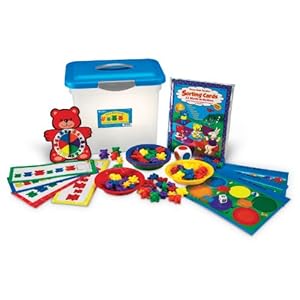
Size & Color Teddy CountersBear Family Counters This is an example of just one of the sets out there.


Learning Resources Three Bear Family Sorting Activity (LER0757)


The set I owned came with all sorts of activities and pattern cards and work mats...games, bowls for sorting...Learning Resource Bears

Look at all the great stuff it comes with for not that much more money!  I need to get myself into a creative mood and try to make some of these things for TpT. I am still learning what is copyright infringement and what is not.  :)

Anyway, this is the perfect story to give the kids practice sequencing 3 items by size.
So after choosing your favorite version of The Three Bears (I think there are a million of them!!) I like to use...dun dun dun...

Yep, you guessed it.  The flannelboard is out again.  I have a few sets of these; came from multiple places round the net and curriculum guides.  If you have a keen eye you may have noticed a spoon missing; I have no idea what happened to it!!  So I copied these on cardstock, colored them in, and laminated for durability.  On the back of one set is magnet tape; I find that hot gluing felt to the back of the plastic laminating material does not last.  So anyway, we use these patterns to tell and retell, just like in the other stories previously posted.  We sequence all the items from the bear's house, we match the sizes to each other and to the right bears.  It's a great co-operative activity as well as center.  I love purposely matching the wrong bed to the bear - the kids get a real kick out of it.

Kathy

Thursday, September 20, 2012

Literature Connections: Fairy Tales part 2

One of my favorite big & small stories is Jack & the Beanstalk. Can't get much more of an obvious size difference that this one!

To start, I needed a giant, a Jack and a beanstalk!  KidsSoup has a set of characters; this giant is from there.  My beanstalk is simply a laminated piece of construction paper that I drew a squiggle on, then cut after it was laminated.  I have one part as a hook to keep it on my flannel board or white board.  There is magnet tape on the back of this set - my white board on wheels was the perfect size to drape the beanstalk down, but since I am at home I had to use the flannel board to show you.


The Jack came from a curriculum book I photocopied from the library.  If I can find the title I will edit the post.

Using the patterns from KidsSoup, we would tell and retell the story, and talk about the difference in sizes of big and small things.  This is a repetition of the other big and small lessons, just with a different story.

The science connection made it an essential fairy tale to use.  We planted some seeds (after comparing their sizes) and tracked their growth.  I just brought in some leftover seeds from home; we planted a couple of each, This does take some time, I admit, to allow for growth but it's fun and by the time the plants are tall enough to measure with a ruler, we've moved onto standard measurement, so I look at this lesson as prep for that one!

I know that standard measurement is NOT part of the Kindergarten Common Core Standards; I see it is not really brought in until 2nd grade now. But this is something I can't ignore when the kids are totally capable of reading a ruler. 

Hands on activity for this fairy tale: walk outside to compare GIANT to BIG to SMALL.  We talked about the difference between something that can be called giant versus something we would call big.  It is so important for young students to understand the language of math.  Great opportunity to introduce TINY as well.

Now, these are all lessons I did with my three and four year olds, minus the measuring the plants with a ruler.  They would use non-standard items like cubes.  The CCS are so easy for measurement that this would be doable with your Kindergarten classes and be aligned perfectly.

Art connection: my youngest students got their own Jack and beanstalk, and practiced cutting on the lines.  They "grew" their beanstalk by picking up the center piece (and bounced it up and down a few times) then I would tape it hanging to the wall, cabinet or table (to spread them out) and they got to move their Jack up and down the beanstalk.  Our positional vocabulary of UP, DOWN, TOP, and BOTTOM was reinforced during this time. 

Next time, yet another fairy tale!!

Kathy

Monday, September 17, 2012

Literature Connections: Fairy Tales

Here are some more literature connections to the Kindergarten Common Core Standard for Measurement.  We are still working with K.MD.1 and K.MD.2.

I will be honest with you, I often have a hard time finding a "good" version of fairy tales.  One that will be appropriate to read to a two-year old as well a a Kindergartener.  But I am sure most of you do not have to deal with teaching that varied of an age group, so it's not a problem for most.  I find that fairy tales can be inappropriate in their language for today's generation.   So I most often ad lib while reading, giving my own interpretation of the story, which is what a fairy tale is anyway, right?

For each fairy tale I retell, I have a set of flannelboard or magnetic story pieces to go along with each.  This way I can retell the story on the board, and when I have a version with good illustrations, I can show it after telling that portion.  Plus, it prevents the little smart-alecs who can read from yelling out "that's not what the story says Ms. Kathy!" LOL

Fairy Tale: The Three Billy Goats Gruff

For this fairy tale, the CCS connection is with the different sized goats.  I use this tale to discuss ordinal numbers - which size goat went first, second and third? We reinforce our positional vocabulary with over and under the bridge.

My public library has TONS of versions of the story, as I am sure does yours.  This way you can pick the version you like the best.

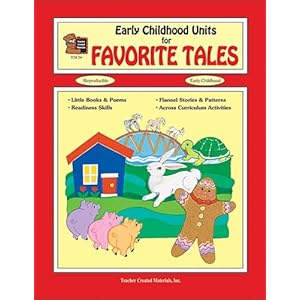
Early Childhood Units for Favorite TalesThe resource I use is: Early Childhood Units for Favorite Tales

This links you to the book on Amazon; I got it as part of a set of 3 or 4 similar books at some point in the past.  Maybe at a book fair? Can't remember.

I claim no ownership of the following images nor do I profit from the posting of them here.

Using patterns from this book I made a slightly larger set of the characters from the story for my white board.  By attaching a small piece of magnet tape, I am ready to go.


Here are my story pieces.


Not the best picture but you get the idea.  After we have told and retold the story, the kids have had a chance to participate in the retelling, and we have practiced using our math vocabulary words, the students get their own set of characters.  Depending on their age, they either get a "coloring" sheet, where they practice following directions like "color the first goat gray."  Getting a bunch of assessments done at once.  I can walk around and jot down a quick note for the kids who struggled with the request.  The older kids get the chance to cut out the pieces and make their own grassy fields for the goats to go from and to.


This is pretty old; it was in my "redo" pile for this school year. :)  All images came from the above shown curriculum book.  I also have one with just a bridge; we can retell the story in other ways with different animals/characters.  This is saved for a workstation.  I forgot something important to mention - the above book also comes with a MINI-BOOK for the students to color and put together.  If you missed my blog post on using "book boxes" you can find it here: Book Boxes

Enjoy!  Kathy

Sunday, September 16, 2012

Measurement: Big & Small

After working on height and length, I then introduced them to the vocabulary words BIG and SMALL.  We discussed in great length how these two words can be used to DESCRIBE sizes in many ways.  Something "big" can either be tall, long, or both.  Something "small" can be short, or short.  Hey - we use the same word in measuring both length & height!  If the kids did not realize it already, which most often they did, we took the opportunity to discuss that many words can have more than one meaning.

Literature to support this unit:


We put on our science caps again and talked about big and small animals, and when time allowed got to look thru books at animals.  I was only teaching math for these lessons, but since I started out teaching science I have never been to fully take that cap off.

The younger classes were given a kinesthetic activity as review.  I held up an item, and they had to "go find" something in the classroom that was either bigger, smaller, taller, longer, or shorter than what I was holding.  They would bring me the item (or if it was not removable like a poster or display I would go to them) and we "measured" or "compared" the items to see if we were correct.  I always took this opportunity to verbalize that I was "lining up" the two items and why we did that.

Kathy

Friday, September 14, 2012

Meaurement: Length

Edit: this post has been getting a lot of views, but my other measurement ones are not. If you you click on Measurement on the right side panel, it will bring up all my posts on measurement for you to review.  Lots of ideas there! 10/29
 
-------------------------------------------------------------------------------------------------------------------------------
Measurement continued!

For the LENGTH lessons, we replaced tall, taller and tallest with LONG, LONGER, LONGEST and HORIZONTAL and reviewed the suffixes and when to use them.  

Those yellow strips came back out and once again we were comparing our strip to each other's strip.  We found our match - the same size, then the two groups found one that was shorter than ours and on that was longer than ours.  Once again, I had the shortest and the longest with me so no one was left out.

Another activity we did was comparing shoe length.  This requires NO advance preparation, fills in a time gap easily, and is fun.  Who doesn't like being able to take off their shoe in school!  Just try not to plan it when you are expecting a fire drill...LOL  Here are some of my pre-K students comparing who's shoe is the "longest" and "shortest."  There is always one kid with really big or really small feet, so you are guaranteed success!


The Long and Short of It


My favorite book to read with this lesson is:


We tie it into science with a discussion of animals and their body parts.   You can offer large picture books and task small groups to find the animal with the longest legs, shortest neck, that kind of thing.


Here is the Kindergarten worksheet that followed.  Great to assess this concept.


This freebie came from Maria at KinderCraze.  You can see the materials on the table - I gave this as a workstation one day.  They cut the strips any where they wanted, then had to sort them appropriately.

Kathy


Thursday, September 13, 2012

Measurement: Height

Measurement: Height!

My school used Everyday Mathematics for many years.  One of my favorite activities from that curriculum I adapted to use with K.MD.1 and K.MD.2.  This activity requires some prep work on your part, but if you laminate the paper before cutting it, it will last you a VERY long time.   

Here is a picture of it in action, then I will explain:


What these two (older threes class) students are doing is comparing two strips of yellow poster board.  I took one regular-sized poster board and laminated it.  I then cut it into ten different sizes strips.  Each size had two strips that matched.  Took a bit of planning, but if you use two pieces of posterboard it may be easier.  The students were randomly handed out a strip.  This was a lesson on height; but was used a second time for length; just hold the strips horizontally instead of vertically.

The students were then charged with the task of finding the strip that was the same size as theirs.  You can see two students lining up the strips and checking to see if they are the same.  Once you found your match, you sat down with your partner so everyone knew you were not available anymore.  This is why you see some students sitting in the background.  Vocabulary for this lesson was: SAME, COMPARE, HEIGHT, VERTICAL.  The next lesson the students again received a strip.  I separated them into two groups; one group stood up with their strips and held them vertically.  The other group had to compare their strip to the standers and find one that was either shorter or longer than someone else's strip.  I made sure to keep one of the shortest and one of the longest strip for me, and when it came close to the end, I would hold up whichever strip was needed and reminded the kids not to forget to compare theirs to mine!  This was no one was stuck with no partner.  I allowed multiples in the partners; the student with a really short strip tended to have a bunch of members from the other team with them at the end.  The searchers then became the standers and the new searchers then had to find the opposite size than had been asked before.  New vocabulary: SHORT, TALL, SHORTER, TALLER.

A third activity had groups of three to five students placing their strips in size order.  This of course is a higher grade level activity, but they were very capable of doing it and they loved the strips.  Vocabulary for that lesson added: SHORTEST and TALLEST.  I used this opportunity to discuss the suffixes -er and -est and when to use them.

Here is my messy portable white board at the end of the ordering sizes lesson. 


Buildings came from KidsSoup.  You can also offer architecture or picture books of buildings and in small groups/centers/workstations have the children look thru the books and discuss the heights of the buildings.  You can turn it into a writing activity as well.

I do use real math vocabulary words with ALL my students. Horizontal  and vertical are not hard words; no words are.  They can learn them just as easily as any other word. 

Kathy

Wednesday, September 12, 2012

Kindergarten Common Core Standards

I am taking a break from the clothesline posts and switching gears to covering the Kindergarten Common Core Standards in Math.  I have mentioned a few times how much I LOVE using literature to teach math; I try whenever possible to tie a math concept to a book and a hands on activity.  My next set of posts will hopefully encourage you to do the same.  So taking one domain at a time, here I go!  

MEASUREMENT AND DATA.

Describe and compare measurable attributes. 

This domain is comprised of three different standards:

K.MD.1. Describe measurable attributes of objects, such as length or weight. Describe several measurable attributes of a single object.

K.MD.2. Directly compare two objects with a measurable attribute in common, to see which object has “more of”/“less of” the attribute, and describe the difference. For example, directly compare the heights of two children and describe one child as taller/shorter.

K. MD.3. Classify objects into given categories; count the numbers of objects in each category and sort the categories by count. 1


1 Limit category counts to be less than or equal to 10.

Let me start by saying this is probably my least favorite of the domains.  I think it is WAY too easy for a Kindergarten class to compare only TWO items. Most of my three year olds last year could tell me which cookie was bigger and which cookie was smaller without even thinking about it!  :) But in all seriousness, I do believe comparing only two items is way too easy. But, since my opinion was not taken into consideration when creating these standards, I will work with what we have been given and will quietly continue to have my students compare up to whatever they are comfortable with.  My Kindergarten class last year did five items without any difficulty.  I am curious as to how the rest of you feel about this.  PLEASE COMMENT AND LET ME KNOW!!  


The next few days make sure to keep stopping by as each post will be something different to go along with this domain.  

Just a reminder, you can click on the Common Core App on the right of my blog ---------------->
at any time!

Kathy